
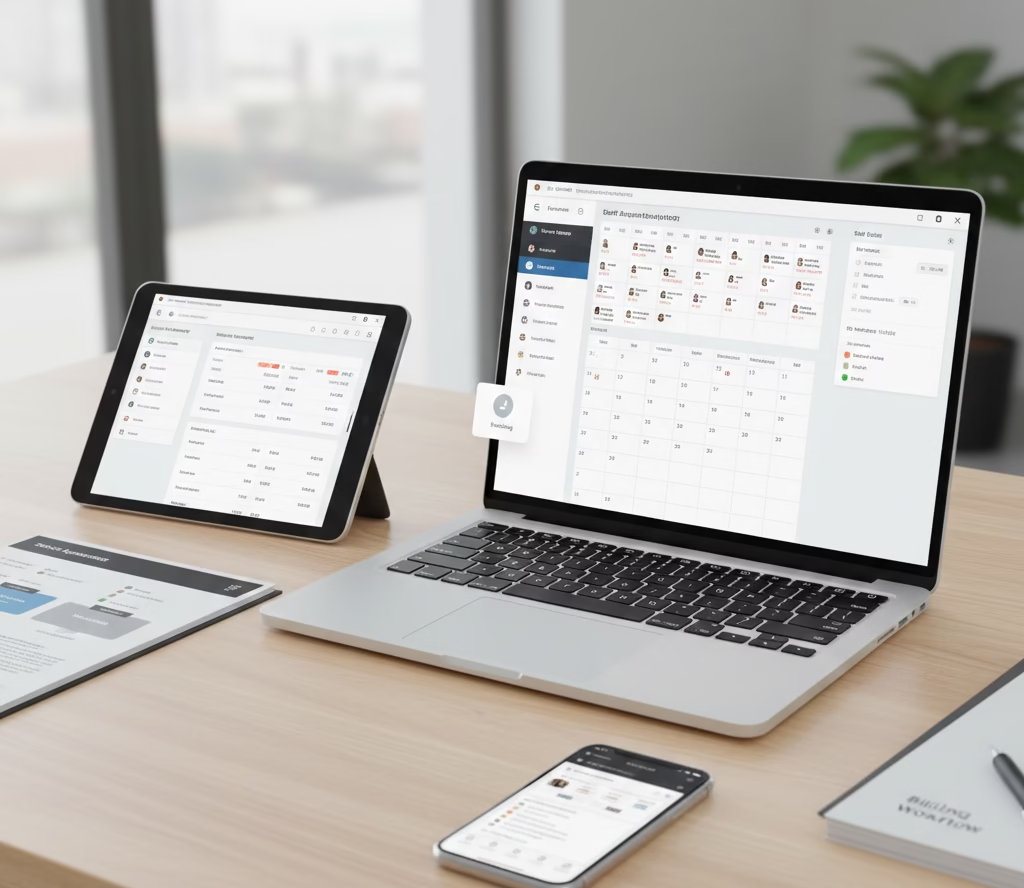
NDIS client scheduling platforms make it easier for providers to handle bookings, recurring shifts, staff matching, and client management in one system.
Choosing the right platform for NDIS client scheduling can make a huge difference to how smoothly a provider operates. After all, scheduling is not only about filling shifts. It also affects participant continuity, staff matching, travel efficiency, timesheets, billing, compliance, and day-to-day communication. As a result, many NDIS providers look for software that combines rostering with client records, invoicing, workforce management, and mobile access in one place.
At the same time, “top-rated” can mean different things depending on your provider size and service model. For example, some platforms offer ease of use, while others support enterprise-style workflows, advanced scheduling, or broader compliance tools. Therefore, instead of asking which platform ranks number one, you should focus on choosing the platform that best fits your NDIS business.
If you are building or improving your NDIS operations, explore our related services for NDIS registration, compliance support, audit readiness, and provider setup guidance.
Why NDIS Client Scheduling platforms matter
To begin with, NDIS scheduling software helps providers manage recurring supports, staff availability, participant preferences, shift changes, and service visibility far more efficiently than spreadsheets or manual systems. In addition, many platforms now link scheduling with care notes, timesheets, payroll inputs, invoicing, and compliance records, which reduces admin duplication and lowers the risk of errors.
Moreover, strong scheduling software can improve participant outcomes.When providers match the right worker with the right participant at the right time, they can deliver more consistent support. Likewise, real-time updates and mobile access can help teams respond faster to cancellations, availability changes, and last-minute roster gaps.
What Features NDIS client scheduling platforms usually include
Before comparing platforms, it is important to know what “good” looks like. Generally, the strongest NDIS client scheduling systems include rostering and recurring shifts, worker availability tracking, client profiles, timesheets, mobile access, travel or transport recording, and integrations for billing or payroll. Furthermore, many providers now expect scheduling tools to support compliance workflows and reduce manual admin across multiple functions
However, not every provider needs the same depth of functionality. For instance, a small provider may prefer a platform that is simple and quick to learn, whereas a larger provider may need stronger reporting, workforce controls, and broader operational visibility. Consequently, the best platform often depends on business size, service complexity, and how much automation your team actually needs.
Commonly Shortlisted Platforms for NDIS Client Scheduling
1. ShiftCare
ShiftCare stands out as one of the most visible platforms in this space and offers an all-in-one system for NDIS providers that covers rostering, client management, billing, and compliance support. It highlights shift setup, team availability, participant management, and broader care management tools, and review platforms currently show it with a large review base compared with many niche competitors. Therefore, it is often seen as a strong option for providers who want an established, broadly used platform with a relatively easy learning curve.
How to Compare NDIS client scheduling platforms
Although feature lists are important, they should not be the only deciding factor. First, look at how each platform handles participant-worker matching, recurring rosters, mobile usability, timesheets, cancellations, and last-minute changes. Next, check whether the system supports your real workflow, including service notes, payroll export, invoicing, and reporting. Otherwise, you may end up with software that looks impressive in a demo but creates extra admin in daily use.
Similarly, think about scale. A solo provider or micro-team may value speed, simplicity, and low admin overhead, while a medium or larger provider may need tighter controls, broader compliance links, and stronger operational reporting. For that reason, the “top-rated” platform for one provider may be completely wrong for another.
Which NDIS client scheduling platforms suit different providers?
ShiftCare stands out as one of the most visible platforms in this space and offers an all-in-one system for NDIS providers that covers rostering, client management, billing, and compliance support. Meanwhile, if you prefer a scheduling-centred option with a newer interface and a strong NDIS rostering focus, RotaWiz may be worth exploring. Providers wanting broader operational tooling may also compare Vertex360 or Supportmate, while more process-driven teams may prefer the structured workflow approach seen in SupportAbility. This is an inference based on each platform’s positioning and public descriptions, not a universal ranking.
Common Mistakes to Avoid
Many providers choose software too quickly based on price, branding, or one impressive feature. However, the bigger issues usually appear later, such as weak mobile usability, poor support, awkward payroll workflows, or limited flexibility for participant preferences and recurring schedules. Therefore, it is wise to test demos carefully, ask about onboarding, and map the software against your actual services before committing.
Likewise, do not assume that more features always mean better value. In some cases, a simpler platform can save more time because staff adopt it faster and use it more consistently. On the other hand, a fast-growing provider may outgrow a lightweight tool sooner than expected. Accordingly, the best decision usually balances ease of use, operational depth, scalability, and support quality.
Final Thoughts
So, what are the top-rated platforms for NDIS client scheduling? In practice, the names most commonly shortlisted include ShiftCare, Brevity, SupportAbility, RotaWiz, Vertex360, and Supportmate, because each offers some combination of scheduling, client management, workforce tools, and operational support for NDIS providers. Nevertheless, the right choice depends on whether you prioritise simplicity, all-in-one functionality, workflow depth, or business scalability.
Ultimately, the best platform is the one that helps your team schedule reliably, reduce admin, support participants consistently, and grow without creating extra operational chaos. Therefore, before choosing, compare the workflow fit, not just the feature list.
For official information on the NDIS and provider responsibilities, visit the NDIS website for current guidance and updates.